



SIT SpA
Lombardy
- From Infrastructure to Integrated Regional Development
- A total investment of €75.78 million, with approximately €25.7 million in public funding
- 9-10 km of new slopes, 2 chairlifts with a capacity of 1,800 people per hour, the Tonale Funicular, and 3 mountain huts
The Project’s Objective
Finance Atena® supported SIT SpA in conducting an economic and financial analysis of the integrated project for the completion of the Ponte di Legno-Tonale ski area and the local public transportation system.
The objective goes beyond simply expanding a ski area: it is to create an integrated system in which new slopes, ski lifts, transportation, service facilities, and connections between the various ski areas can enhance the destination’s overall appeal and attract new tourists. The business idea is summarized in the project through a direct relationship: greater integration of the ski network and improved mobility generate increased tourism.
Finance Atena® has transformed this infrastructure vision into an economic-financial model through which to measure investments, revenues, costs, funding sources, profitability, and the bankability of the project.
The Project Under Review
The project is part of an already established area. Between 2004 and 2006, the connection between Ponte di Legno and Passo del Tonale was completed, while the subsequent Cima Sorti project was included by the Lombardy Region among the strategic initiatives for economic revitalization, with a planned contribution of 25 million euros.
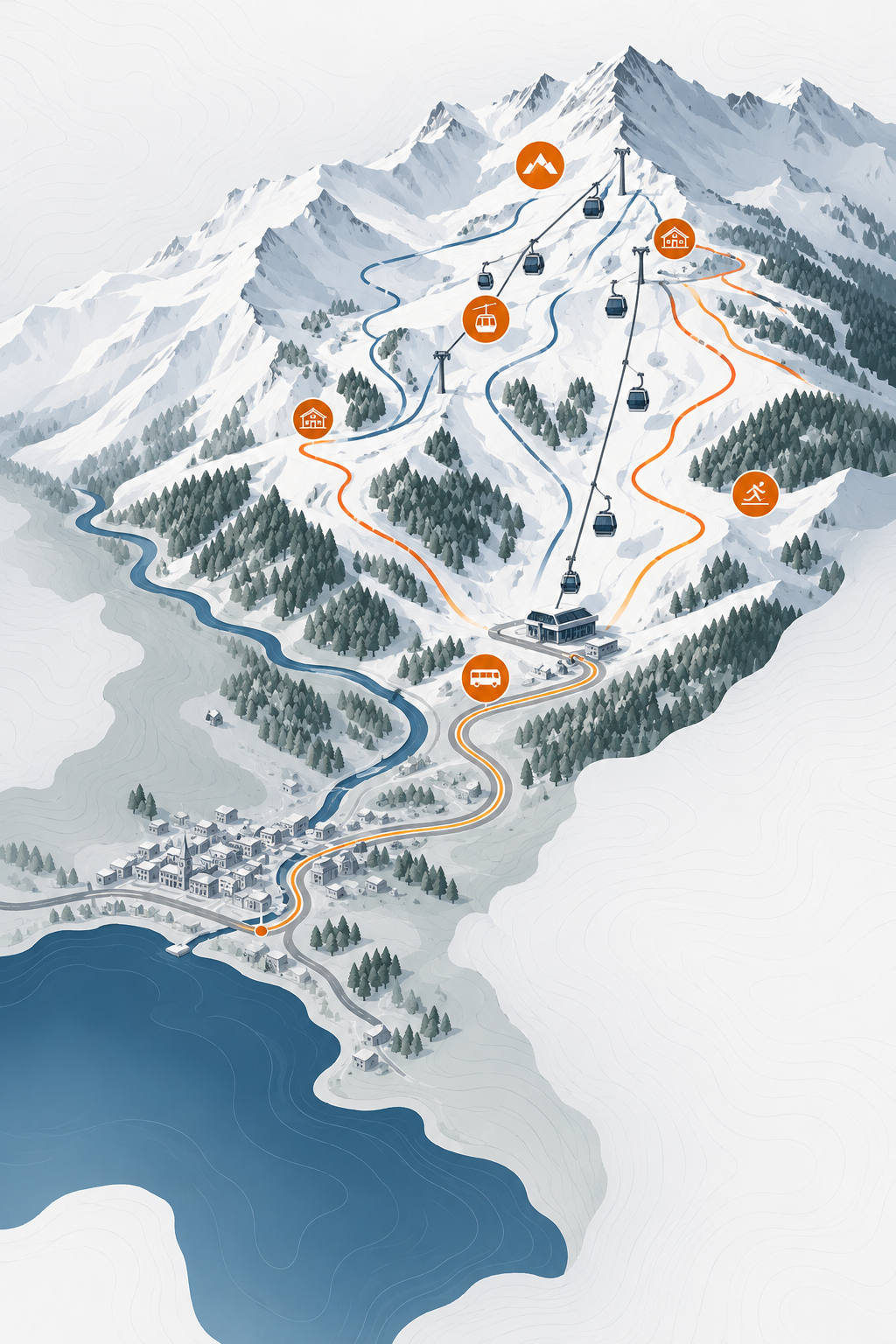
The project involves a new ski area organized around three main components.
The first concerns Cima Sorti, featuring two new gondola lifts, seven new runs totaling approximately 9-10 km, automated snowmaking systems, a 35,000 cubic meter reservoir, utility networks, parking lots, and ancillary structures. The two gondola lifts are designed with a capacity of 1,800 people per hour each.
The second component involves the completion of the Tonale Funicular, which is also intended to strengthen local public transportation between Ponte di Legno and Passo del Tonale. The third component involves the construction of three mountain huts to serve skiers and visitors.
The project also aims to create a true ski “Carosello,” facilitate future access to the Valtellina, better connect the Lombardy and Trentino regions, and offer new technical runs even during the spring months.
The Finance Atena® Method
Finance Atena® analyzed the project as a system composed of different business units, each characterized by investments, costs, and revenue-generating mechanisms.
The model primarily distinguishes between the Cima Sorti Ski Area, the Tonale Funicular, and the Alpine Mountain Huts. For the Ski Area, revenue is generated through a fixed component linked to the value of the lifts and a variable component linked to the actual number of riders. For the Funicular, the model considers ticket prices and ridership; for the Mountain Huts, minimum annual fees necessary for economic sustainability are defined.
Finance Atena® has also modeled the Ski Area’s drivers in detail, assigning values, allocation percentages, and estimated ridership to each lift. The model thus arrives at a forecast of gross revenue (excluding VAT) for the ski area of approximately €3.49 million per year, supplemented by approximately €344,000 for the funicular and €250,000 for the mountain huts.
The soundness of the assumptions was also compared with the ski area’s historical demand. Total admissions had grown from 823,802 in the 2015–16 season to 891,977 in 2018–19, while revenue from lift operations had risen from approximately €8.14 million in 2016/17 to €9.75 million in 2018/19.
The Added Value of Finance Atena®
The added value of Finance Atena®® wasto transform a major infrastructure project into an economically quantifiable undertaking, linking public and private investment, operational management, revenue-generating capacity, and financial sustainability.
The infrastructure projects analyzed total approximately €64.9 million: €55.28 million for the expansion of the ski area, €3.82 million for the funicular, and €5.78 million for the mountain huts. The financial model also factors in a total initial investment of approximately €75.78 million, in addition to the extraordinary maintenance expected over the operational lifespan.
Finance Atena® also structured and analyzed the mix of funding sources: €5 million in equity from the operator, €5 million in shareholder financing, approximately €30.03 million in bank debt, a VAT line of credit of approximately €10.83 million, anticipated public grants totaling approximately €25.7 million, and self-financing capacity also earmarked for subsequent projects.
At full capacity, the forecast model shows revenues in the range of €3.8 million annually and EBITDA of approximately €2.48 million, both of which are expected to grow progressively in subsequent years.
However, the evaluation does not stop at profitability. Finance Atena® has measured the project’s ability to create value and service debt: the model indicates a Project NPV of €11.73 million, an Equity NPV of €1.78 million, a Project IRR of 4.488% compared to a WACC of 2.689%, and an Equity IRR of 9.448% compared to a cost of equity of 7.591%.
Bankability was also assessed: the model shows a Senior DSCR of 2.902, a Senior LLCR of 1.646, and a tail period of 15 years—indicators used to evaluate the transaction’s ability to service the debt over the long term.
A new value story
The New Cima Sorti–Tonale Integrated Ski Area project demonstrates how Finance Atena® can contribute to a major regional infrastructure project by going beyond a simple analysis of construction costs.
Value comes from integration. The gondola lifts increase accessibility; the new slopes expand the offering; snowmaking improves the continuity of the season; the funicular strengthens local mobility; the mountain huts generate new services; and the integration between Lombardy and Trentino boosts the competitiveness of the entire ski area.
Added to this is the operator’s solid track record: SIT SpA, founded in 1949, has a long history of constructing and managing ski resorts and ropeway systems and is an integral part of the development of the Adamello Pontedilegno-Tonale ski area.
Finance Atena® has made this relationship between infrastructure and economic development measurable, translating the project into a model capable of demonstrating how each investment can impact demand, revenue, profit margins, bankability, and value for the region.
Finance Atena®: transforming infrastructure and the local area into an economic and financial model capable of generating new value.
Simula il futuro della tua impresa
Scopri come l'Analisi Predittiva può aiutarti a simulare scenari futuri, ottimizzare investimenti e ridurre i rischi. Affidati ai consulenti Finance Atena® per trasformare dati e modelli di business in decisioni profittevoli e sostenibili.
